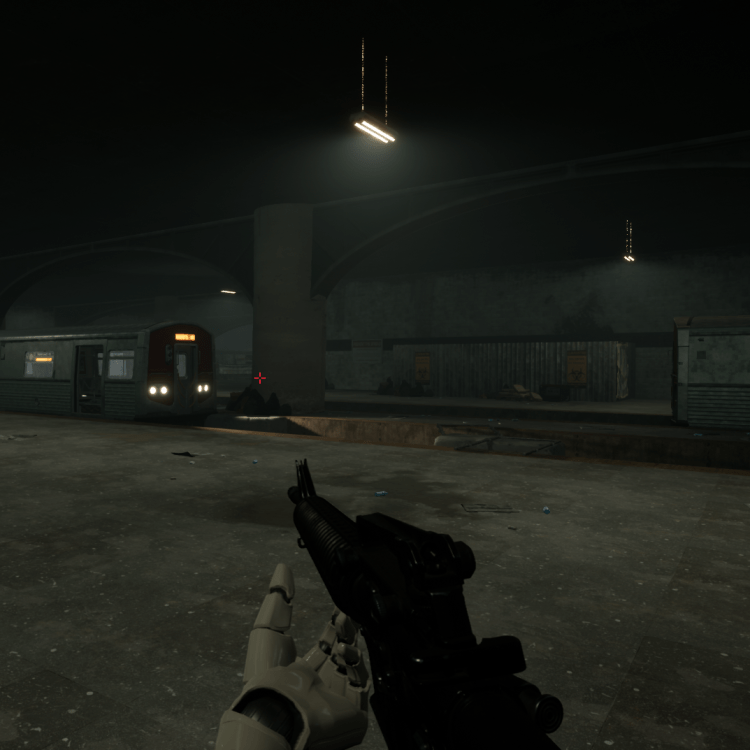
PARK STATION
I wanted to try making a level in the style of Back 4 Blood after seeing various streamers play through the demo level before the game released. I always liked the level design of the Left 4 Dead series and wanted to create a level that was linear, but still offered the player avenues to navigate and open up the world.
Responsibilities
- Designed the level from concept to final polish
- Programmed all logic, AI, and mechanics in the level
- Created a procedural spawner for enemies and loot
- Playtested level with friends and family
- Implemented lighting, post-processing, and art passes
Details
- Engine: Unreal Engine 4
- Language: Blueprints
- Duration: 4 Months
- Size: 1 Person
- Software: Blender, Perforce



Concept
The Cleaners received a distress call from a neighboring settlement they thought was abandoned on the other side of the city. After being ambushed by Ridden on their way over, the crew decides to cut through the city using the subway system, but what they find underneath the city shakes them to their core…
Mechanics
The mechanics I recreated for this level were the procedural loot generation system and the zombie AI with a very simplistic Director controlling their spawns. Though it wasn’t very necessary to recreate these for the level, it was a fun extra challenge for myself that ended up teaching me a lot more than I thought. I programmed everything myself.
Pre-Production
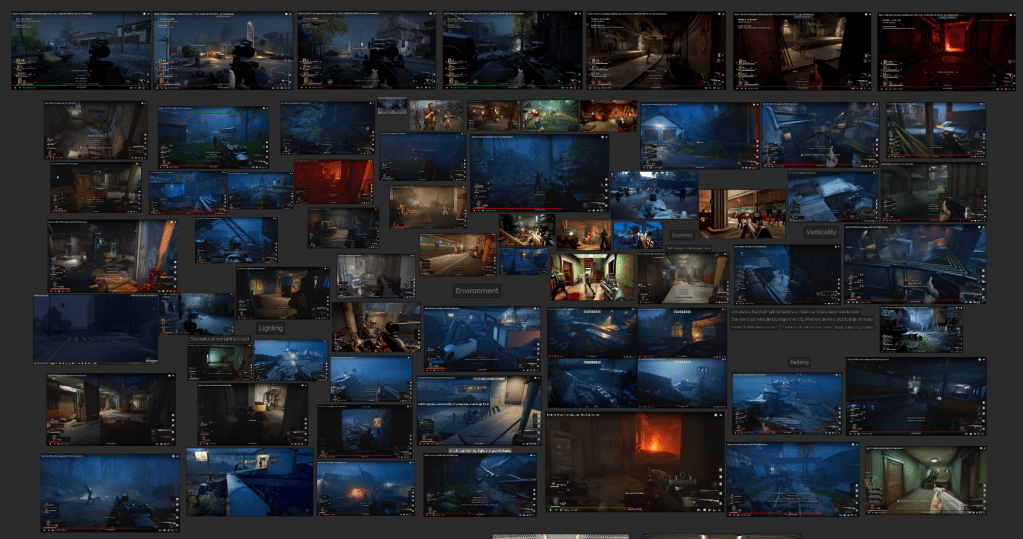
This level was tricky in that I wasn’t actually able to play the game to get a feel for anything. I had to go off footage of streamers playing the demo level to try to create my own. What I did have, however, was Left 4 Dead 2, which I played to try to get the feel I was missing. I knew that I needed to create something that wasn’t that game, but the two were similar enough in style that I could approximate what I needed. The level needed to be linear, without feeling like it was linear, so I tried to put in as many different paths within a larger area as I could. Even if players gravitated towards a specific path, there was always another way they could have taken. To combat this further, I wanted to differentiate spaces visually as much as I could so that it didn’t feel too “same-y.” After re-watching a lot of footage, I sketched out my ideas to get a rough idea of my level’s flow, spawns, and layout.
Layout
The above is full layout of the level, with the differently colored lines representing different paths players could take, although it’s not exhaustive. Orange circles designate weapon crates, while yellow spots (not lines) designate stash/loot rooms. Below, I will go through each area in a little more detail.
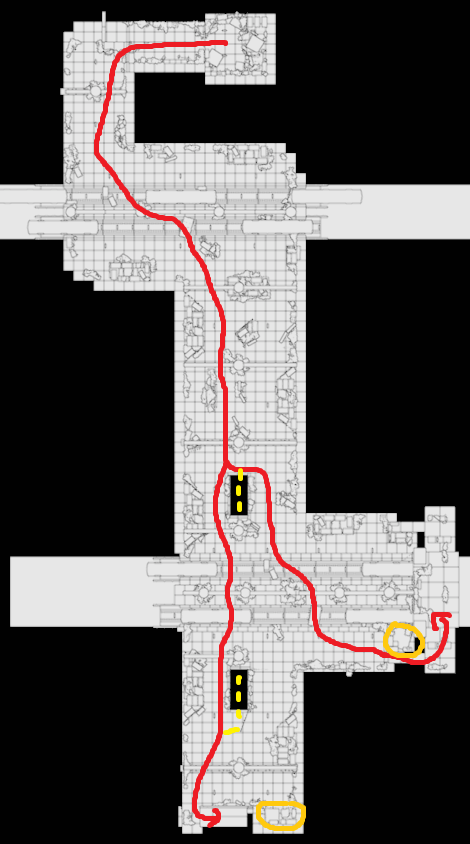
A full map of the first level of the subway with the players starting at the top and having to make their way across two subway platforms to go up to the next floor. The yellow dotted lines enter and exit the lowest floor of the subway, which is another platform that acts as a “shortcut” of sorts to avoid the enemies above. There is a “secret” room with several weapon crates near the first path to the right, but it is easy to miss. A more obvious crate sits near the end of the second path, but there is only one. Either path will bring players to a room blocked by security gates.
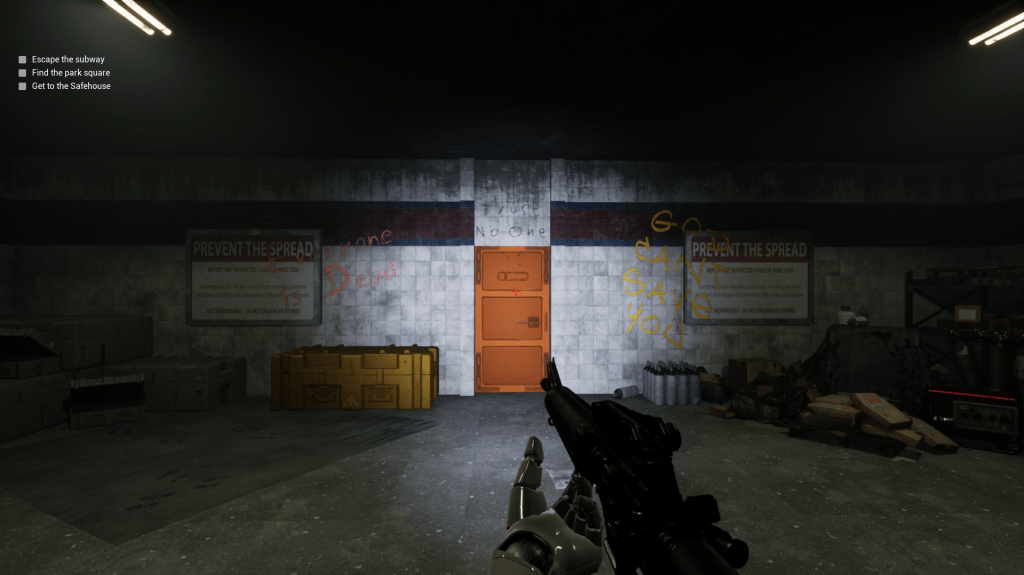
The opening room, hallways, and first platform. Players can take a variety of different paths both through, over, and around train cars. There are loot spawns scattered around the edges of the platform and in the cars.

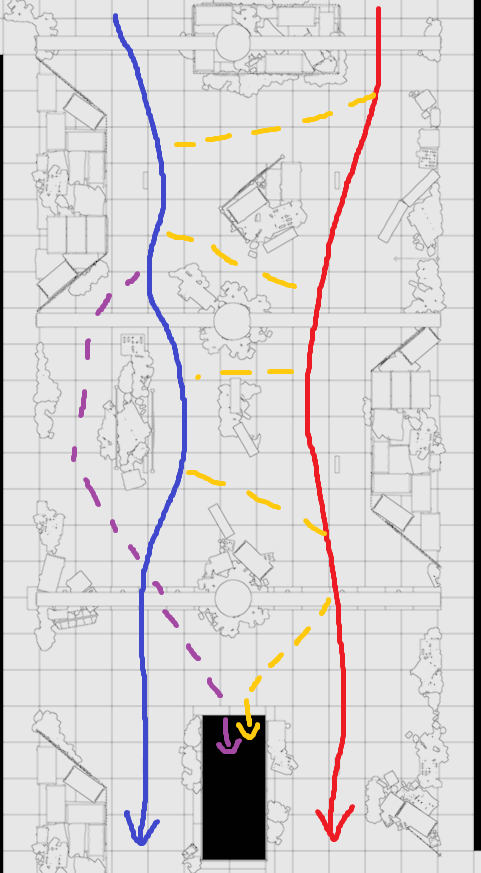
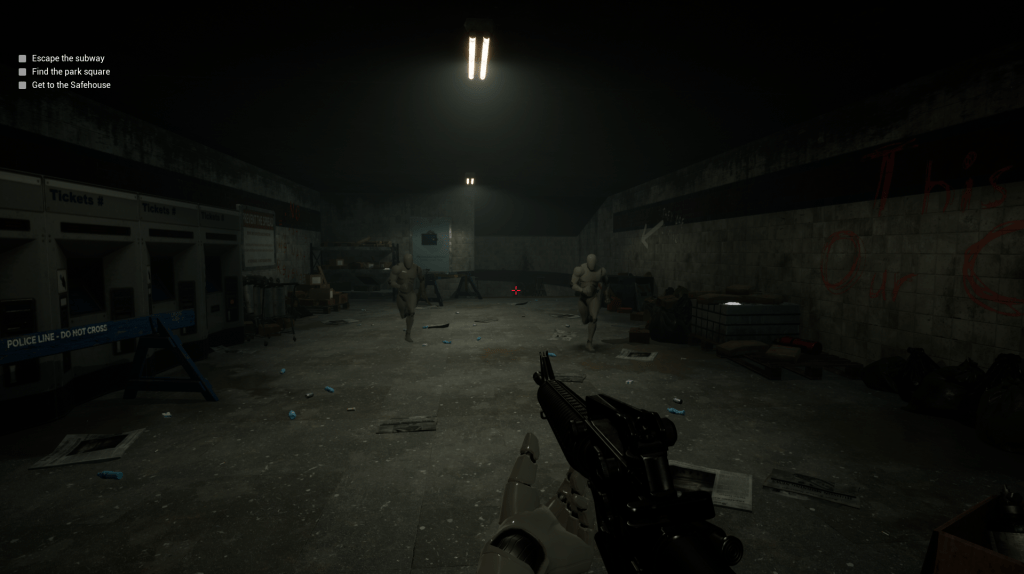
The long hallway connecting platforms 1 and 2. Again, players can take a variety of different paths around the debris. The hall is wide enough to accommodate the players and larger enemies. There are loot spawns scattered all over the hallway.
The second platform and small side room leading to the next floor. Players can take a variety of different paths around, through, and under the platform and in, over, and out of the cars. The paths to the right are quicker, but lead to less loot. The paths to the bottom have you go through more enemies, but you will receive more loot in the next room. There are few loot spawns scattered all over the platform and more in the trains.


The basement platform. Players can move in and out of train cars. The platform is short and players who lag here can be overrun, but it’s a good way to avoid the chaos upstairs. There are loot spawns throughout the cars.
The large side room and main station lobby. Players are stuck in their respective rooms, blocked by security doors that will alert the Horde when they are triggered. The lobby has two levels accessible by stairs, since the elevators are broken. Though there are many paths through the lobby, they all converge into one hallway that leads to the outside.
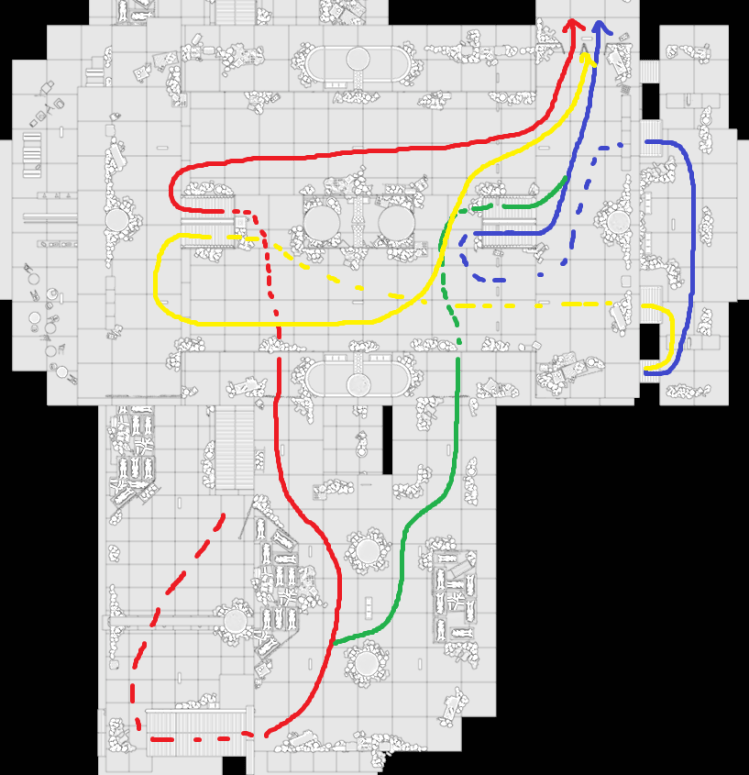

The large side room. Players who chose the long way are rewarded with a loot room if they choose to access it. Otherwise there is a little bit of loot scattered in the rest of the room.
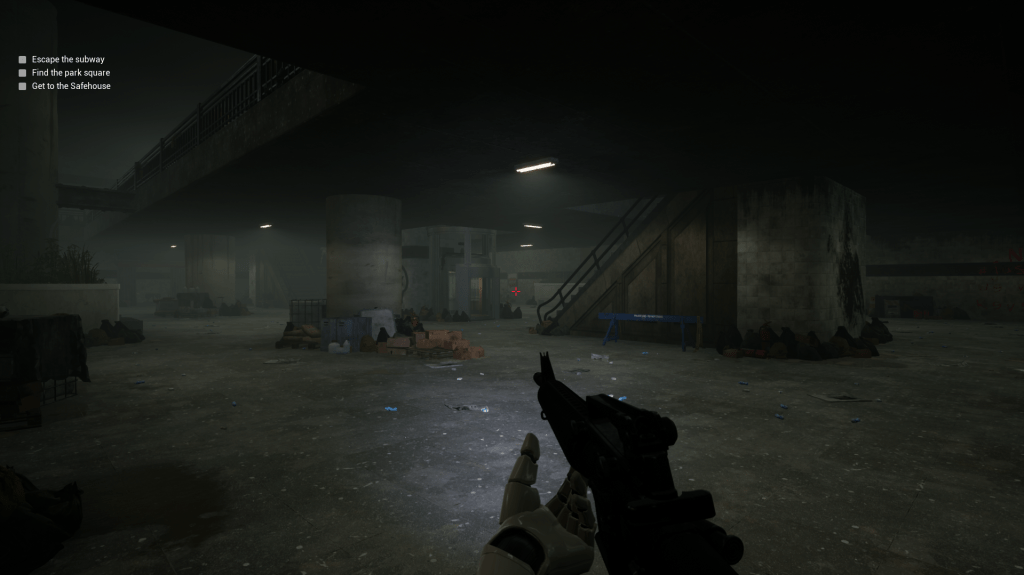
The first floor of the lobby. Players will be fighting a horde through this area. The different paths come from the different doors leading in, although if you only came from one of the rooms, the doors for the other room will not open, to avoid players going the wrong way. All paths lead up the stairs to the next floor. There are some loot crates in the restaurants on the left side of this floor and loot scattered throughout.

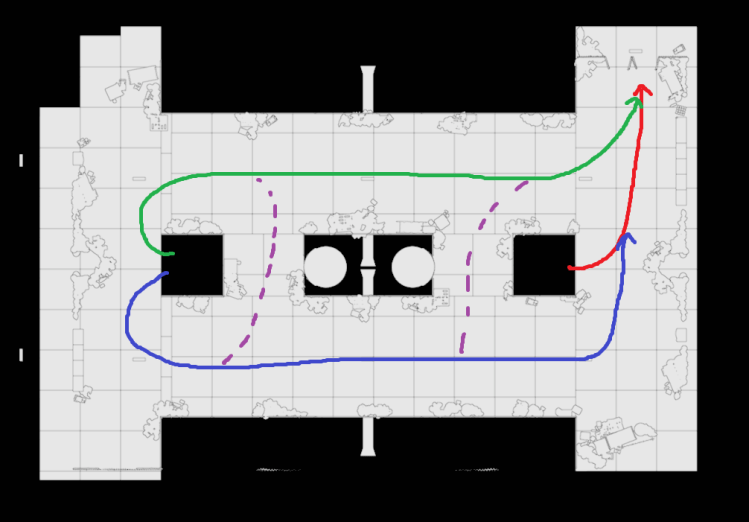
The second floor of the lobby. Players may still be fighting a horde through this area. Depending on the stairs they took, players may be closer or farther from the exit. The farther stairs were closer to the crates downstairs, and give better access to the loot on this floor, but the closer stairs mean you don’t have to fight through as much.
The exit of the subway. It’s a straightforward path, but players will be fighting one final large group of enemies. They can also dip into the adjacent restrooms for loot and health.
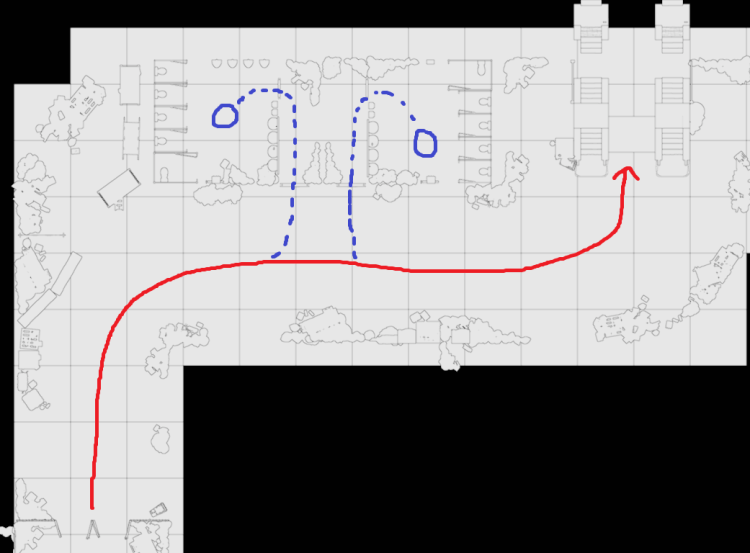

The streets. Having finally exited the subway, players will find themselves outside on the city streets at night. They can traverse through broken down cars on the street, move through a piece of the park, or cut through a nearby restaurant to get to the next area. Regardless of their choice, there will be a weapon crate for them along the path; however, those who choose the restaurant have a chance to find a loot room on either the outside or inside of the building. There is loot in the cars, but trying to get it may set off alarms that trigger a horde.
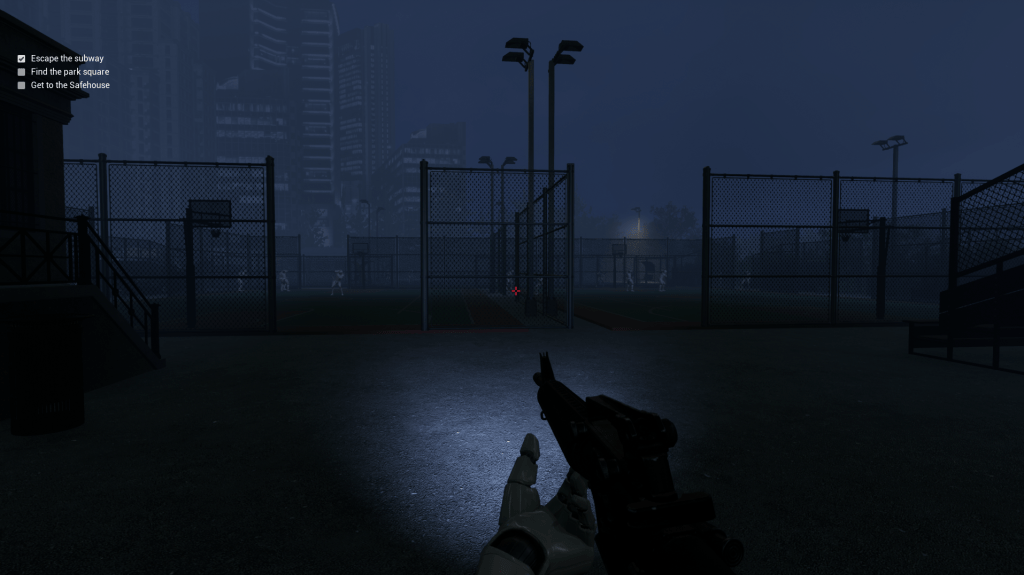
The sports area of the park. Players will be avoiding the road blockages by cutting through a park. Loot can be found around the edges of this space on the bleachers. Players have a few ways through the basketball and tennis courts in this space. On their way out, they will see the sprawling next area, and three paths to enter it.
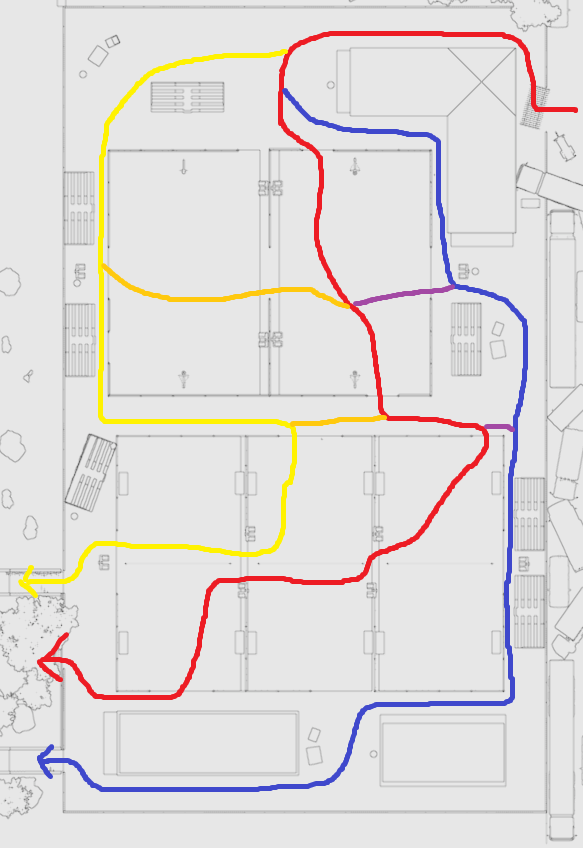
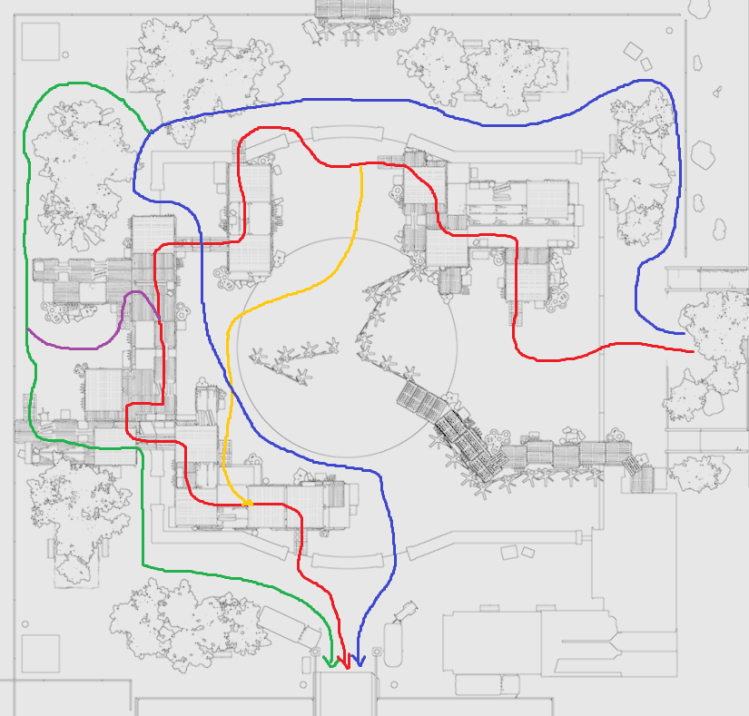
The park fort. In the park square lies an abandoned fort now teeming with enemies. Players have many paths to choose around and through the aquare and the fortifications within. Blockages force them to loop around the fountain. Loot can be found all over this area; the space where the purple line is houses some crates and extra loot, plus there is more on the outskirts. Players will converge on the exit.
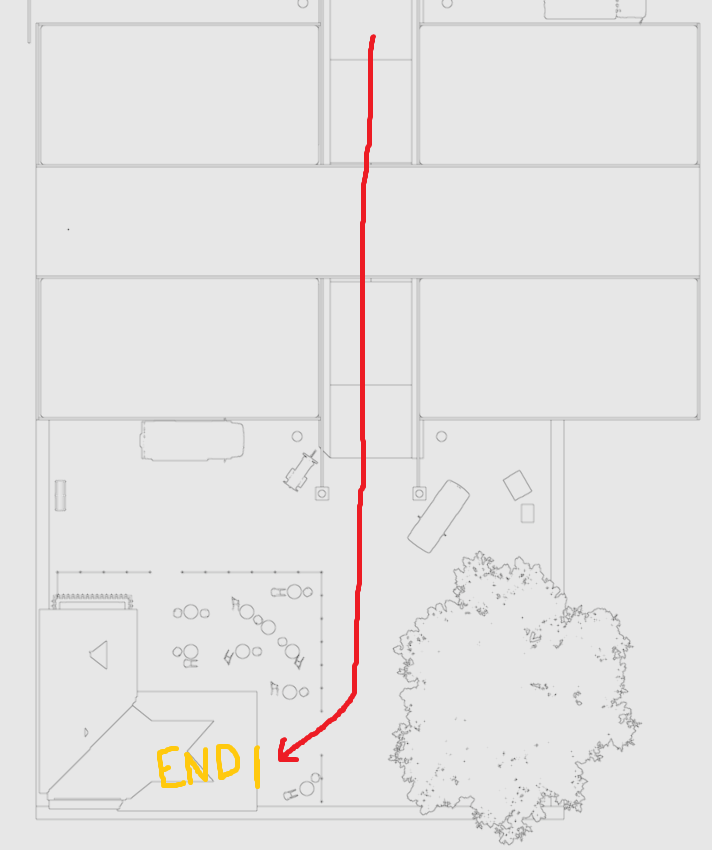
The exit in the park cafe. After going through an underground walkway, players will end up in a cafe area. There is some loot around this area as well as the exit door, which will end the level once all players are inside.
Blockout

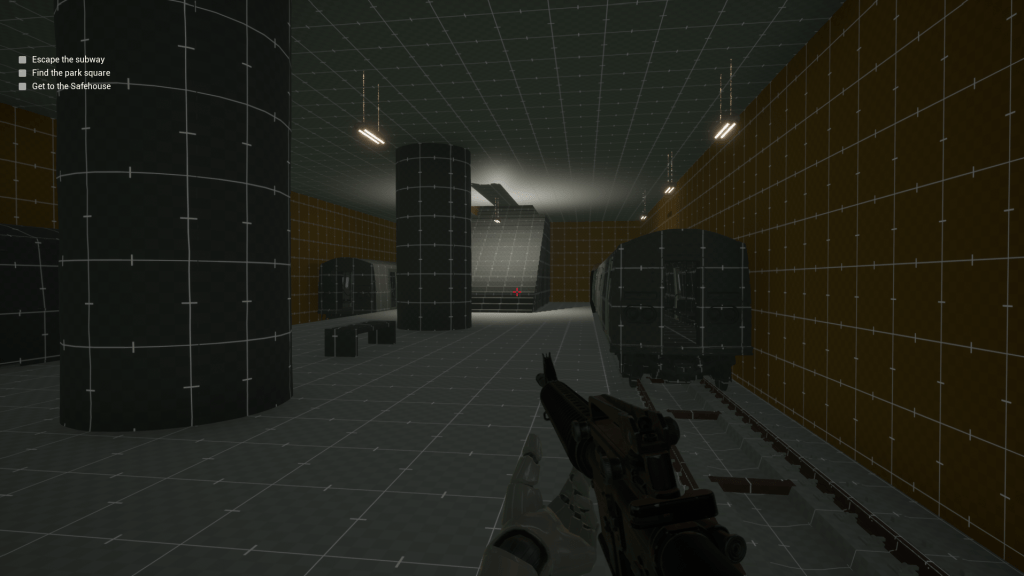
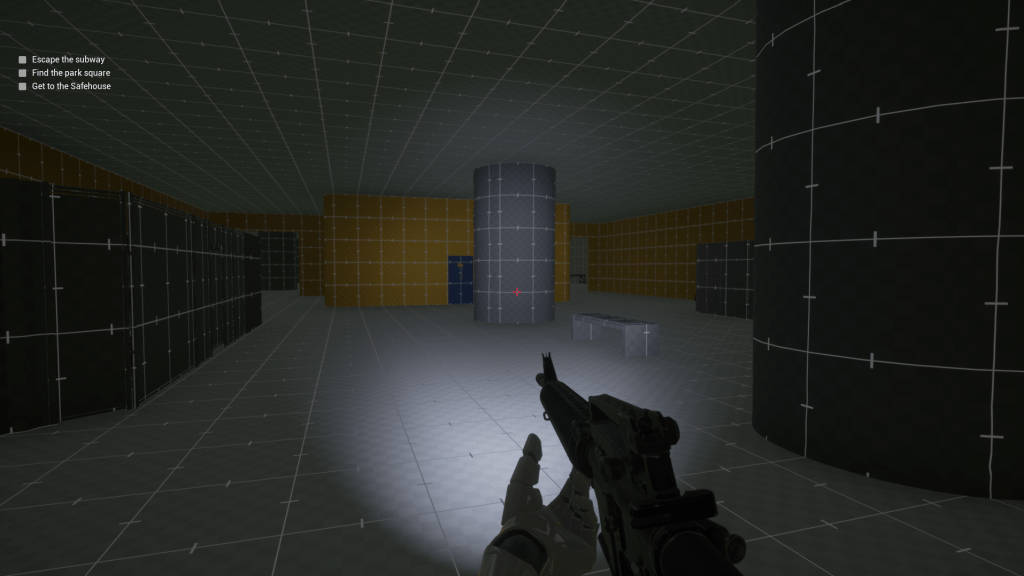
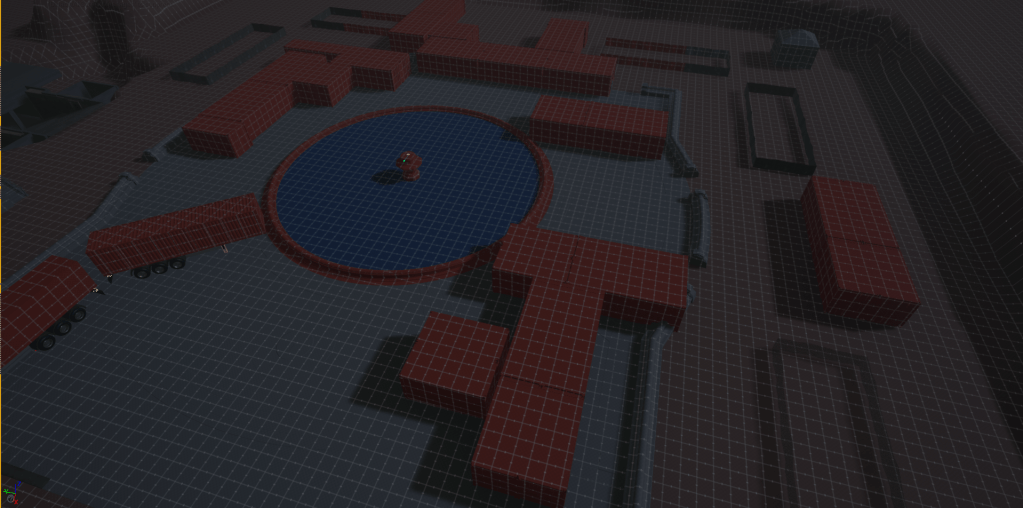
I blockout in Blender and then export to Unreal to play around in my maps. It was important for me to create a level that four people could run around in, that could also house a number of larger than usual enemies and a large number of smaller ones. As with all my levels, I iterated based off playtesting. The above are from a few blockouts in the middle of the process, but the level was updated a few times in response to player feedback that the level was too short and too linear.
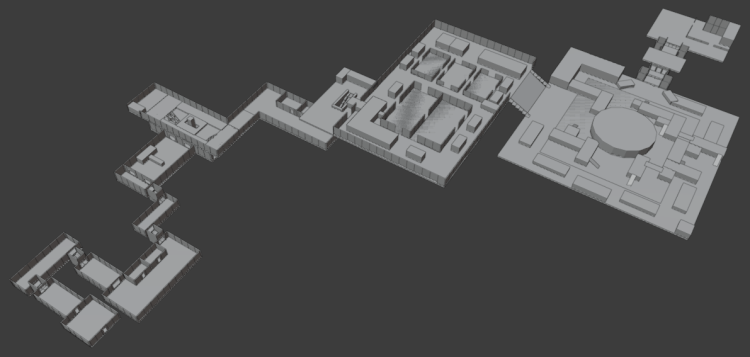


My initial blockouts felt way too small for the scope of the level I was going for, and my first blockout actually felt too small physically, so I scaled everything up and added more length and space. As seen above, the complexity of the level, and the subway in particular, grew tremendously as a result. There’s a couple different places in the level, such as the second train platform, the lobby, or the park fort, where I would put some mechanics/scenarios that weren’t in the initial demo, like when players need to clear an area of blockages by shooting weak spots on the environment, all while being attacked by several large and dangerous enemies or when they can’t move on without fighting a boss enemy.
Polish
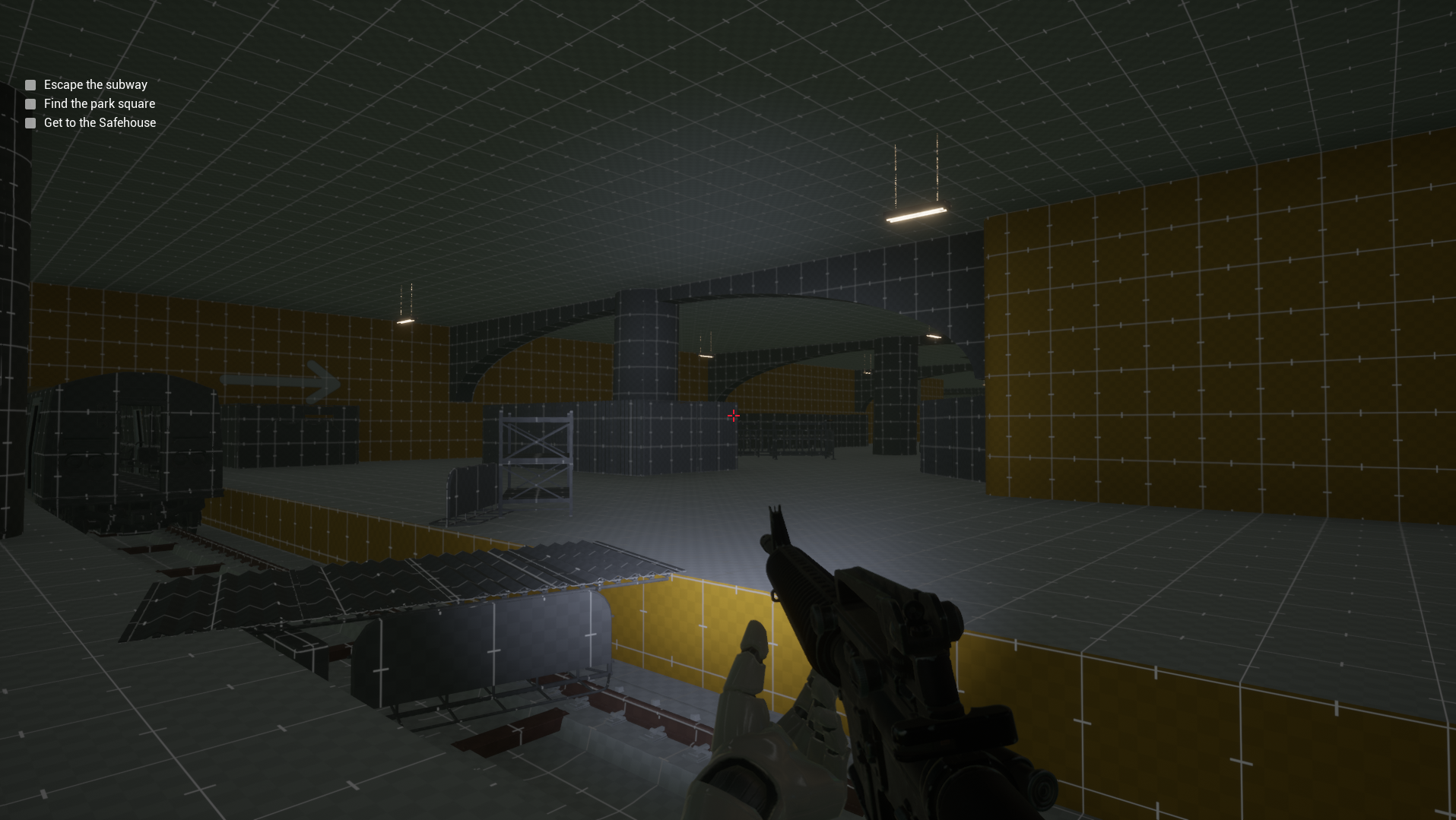
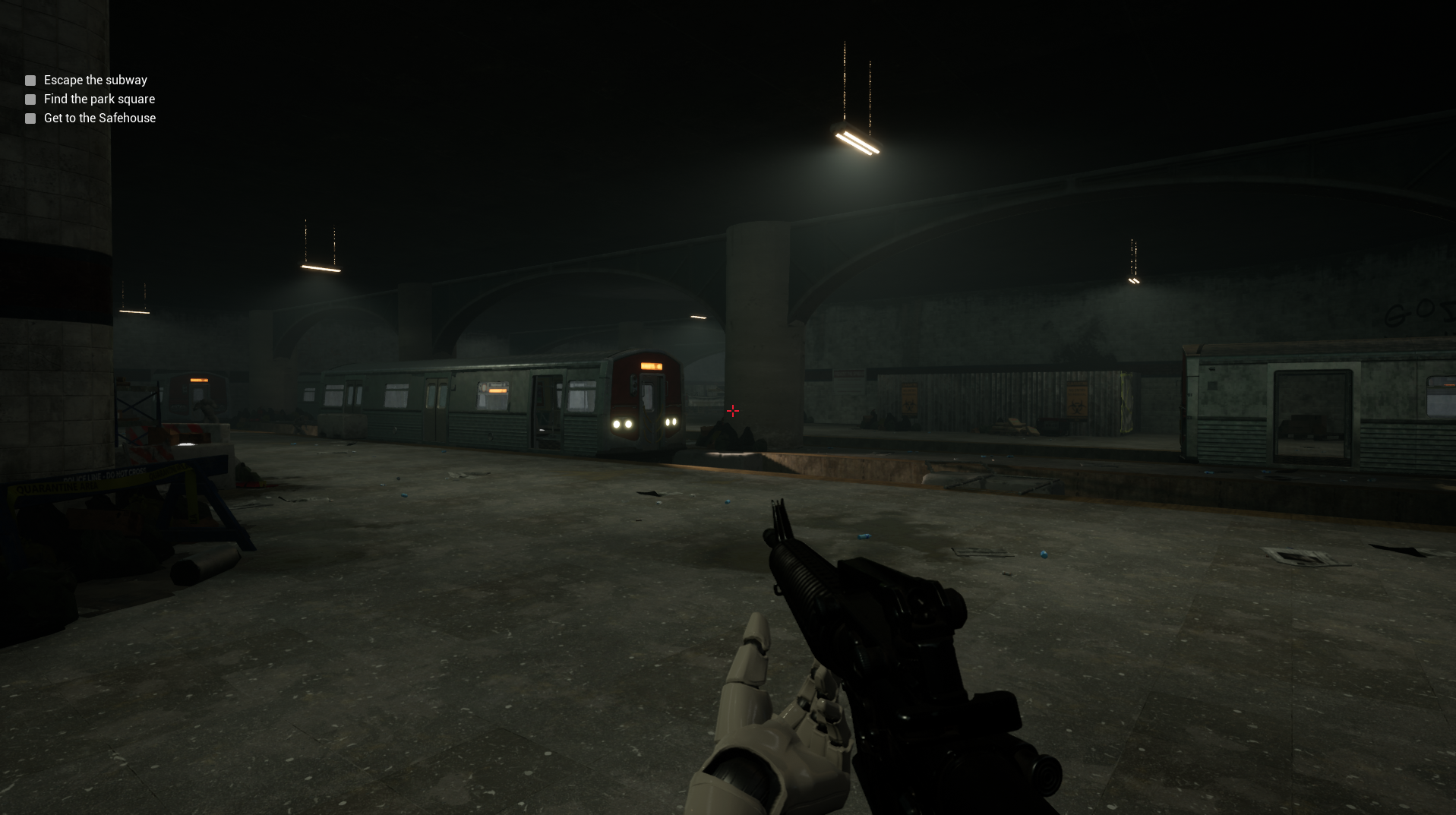
I was able to get a majority of my assets from packs I already owned, but for everything else, I went to Sketchfab. This level was a learning experience for a couple different reasons. First, when I first created the zombie spawner, I was doing it for fun. What I didn’t realize at the time was that it was going to teach me to better design my levels for optimization. With so many zombie spawning at once, the game ended up chugging very noticeably in certain locations. Specifically, I recognized that I should have made the long hallway players traverse from one train platform to another either a U or S shape. This would have made a more interesting path and helped with loading/unloading parts of the level.
Second, was the lighting and post processing that I needed in order to do a nighttime map. This level pushed me to better my lighting skills and learn more about Unreal’s post processing volume, which I had only used pretty basically. Those two aspects also added to my performance woes, although the zombies are what threw off performance. I like to put in art assets to see how my level works with “final” art, and this is the reason why. Without doing so, I would have never learned how to more effectively design for performance and optimization.






 Patrick Lancaster